Art movement
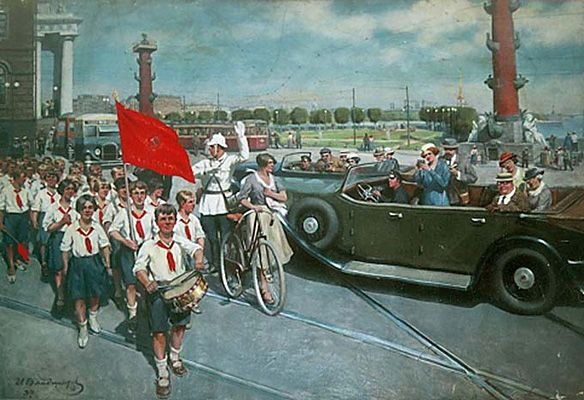
Socialist realism is an influential style of art that emerged in the Soviet Union and became widely adopted in socialist countries. It is characterized by the idealized portrayal of communist values through realistic imagery, particularly highlighting the emancipation of the proletariat. It is important to note that socialist realism should not be confused with social realism, which focuses on depicting social issues.
In the Soviet Union, socialist realism became the dominant form of approved art from the early 1920s until the late 1960s. While other European countries also had prescribed art canons, the Soviet Union’s adherence to socialist realism was more stringent and enduring.
The development of socialist realism involved the contributions of numerous artists across diverse backgrounds and spanned several decades. Early examples of realistic art in Russia can be seen in the works of the Peredvizhnikis and Ilya Yefimovich Repin. Though these works lacked the same political connotation, they laid the groundwork for the techniques embraced by later artists.
Following the Bolshevik Revolution in 1917, there was a notable shift in artistic styles. The interim period between the fall of the Tsar and the rise of the Bolsheviks saw a brief period of artistic exploration. However, after the Bolsheviks seized power, Anatoly Lunacharsky, as the head of Narkompros (the People’s Commissariat for Enlightenment), played a pivotal role in shaping the direction of art in the newly formed Soviet state. Lunacharsky established an aesthetic system centered around the human body, which became a central element of socialist realism for years to come. He believed that art had a direct impact on human well-being and that it could inspire positive change. Lunacharsky’s vision was to educate citizens on how to embody the “perfect Soviet” through the depiction of “the perfect person” (the New Soviet man).
Within the Soviet art scene, there were two main factions: the futurists and the traditionalists. The futurists, many of whom had previously engaged in abstract or leftist art before the Bolshevik era, believed that communism necessitated a complete break from the past, and therefore Soviet art should reflect this rupture. On the other hand, the traditionalists emphasized the importance of portraying everyday life in a realistic manner. During Lenin’s rule and the implementation of the New Economic Policy, there was a certain level of private enterprise, which allowed both the futurists and traditionalists to create art for individuals with capital. However, by 1928, as the Soviet government consolidated its strength, private enterprises were abolished, effectively ending support for fringe groups like the futurists. Although not yet referred to by the term “socialist realism,” the defining characteristics of this artistic style had already become the norm.
The official use of the term “socialist realism” first occurred in 1932 during meetings that involved high-ranking politicians, including Stalin himself. Maxim Gorky, a prominent advocate of literary socialist realism, published a renowned article titled “Socialist Realism” in 1933, and the term’s etymology was eventually traced back to Stalin. It was during the Congress of 1934 that four guidelines were established as the foundation of socialist realism. According to these guidelines, socialist realist works were required to fulfill the following criteria:
 Emad Taha