Art movement
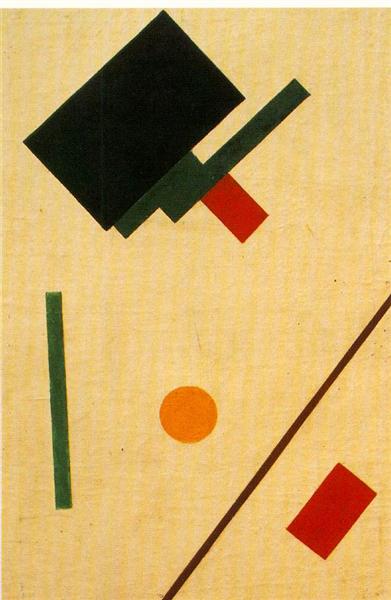
Suprematism is an influential art movement that emerged in Russia in the early 20th century. Founded by the visionary artist Kazimir Malevich, Suprematism focused on the exploration of basic geometric forms, such as circles, squares, lines, and rectangles, all painted in a limited range of colors. It made its striking debut in 1915 at Malevich’s groundbreaking exhibition, The Last Futurist Exhibition of Paintings 0.10, held in St. Petersburg.
Malevich, who had already established himself as a notable painter, developed the concept of Suprematism after participating in other art movements like cubo-futurism. The artistic landscape of that time was undergoing a remarkable transformation, with a rich diversity of new forms emerging in painting, poetry, and theatre. Simultaneously, there was a renewed interest in the traditional folk art of Russia. Within this vibrant cultural environment, a Modernist culture was born.
In his book “The Non-Objective World,” Malevich defined the core concept of Suprematism, establishing a grammatical system based on fundamental geometric shapes, most notably the square and the circle. His seminal 0.10 Exhibition in 1915 showcased his early experiments in suprematist painting. The centerpiece of the exhibition was the iconic Black Square, which symbolized a breakthrough not only for Malevich’s career but also for the trajectory of art itself. Another significant work was “White on White,” representing a shift from polychrome to monochrome Suprematism.
Suprematism, in essence, stood in opposition to other postrevolutionary movements like Constructivism and materialism. While Constructivism emphasized utilitarian strategies and functional organization, Suprematism embodied a profoundly anti-materialist and anti-utilitarian philosophy. Malevich believed that art should transcend and liberate from the constraints of materiality, calling for the artist to be both the originator and transmitter of absolute non-objectivity.
Although there may be superficial similarities between Suprematism and Constructivism due to the involvement of certain artists, such as El Lissitzky and Alexander Rodchenko, it is essential to distinguish between the two. These artists either directly associated themselves with Suprematism or were influenced by it but later shifted their focus towards material culture.
Suprematism does not revolve around a humanist philosophy that places man at the center of the universe. Instead, it envisions the artist as the generator and communicator of the sole true reality according to Malevich: absolute non-objectivity. To him, this liberating non-objectivity was a blissful state that transcended the constraints of the physical world.
In Malevich’s vision, the future of the universe would be built upon the foundations of absolute non-objectivity. This future would prioritize pure feeling over appearances, objects, comfort, and convenience. Suprematism aimed to challenge and transform the very nature of art, paving the way for an artistic expression that transcends the limitations of the material world.
 Emad Taha