Art movement
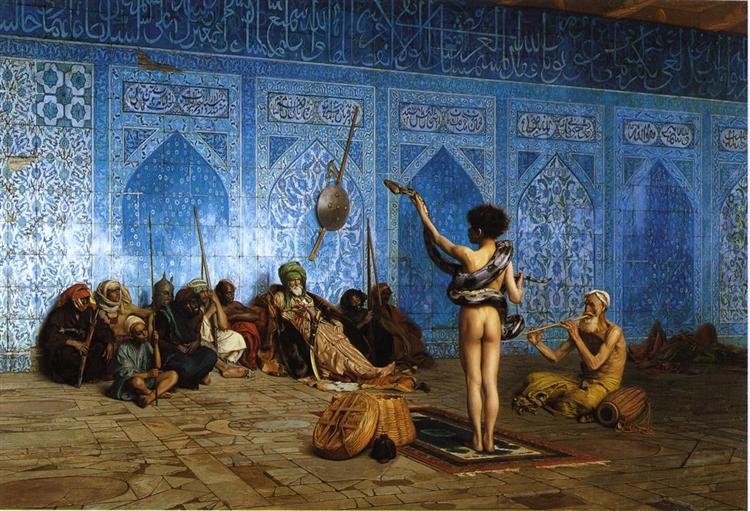
Populating their paintings with snake charmers, veiled women, and courtesans, Orientalist artists created and disseminated fantasy portrayals of the exotic ‘East’ for European viewers. Orientalism primarily refers to Western (particularly English and French) painting, architecture, and decorative arts of the 19th century that utilize scenes, settings, and motifs drawn from a range of countries including Turkey, Egypt, India, China, and Algeria. The movement covered a range of subjects and genres from grand historical and biblical paintings to nudes and domestic interiors, falling broadly under Academic Art. While some artists aimed for realism, many others absorbed the individual cultures and practices of these countries into a generic vision of the Orient. As historian Edward Said notes in his influential book, Orientalism (1978), “the Orient was almost a European invention…a place of romance, exotic beings, haunting memories and landscapes, remarkable experiments”.
The roots of Orientalism can be traced back to the 15th century. During the war between Venice and the Ottoman Empire from 1463 to 1479, Venice experienced defeat and had to pay indemnities to continue trading on the Black Sea. In 1479, Gentile Bellini, the official court painter for the Doge of Venice, was sent as a cultural ambassador to work for the Sultan of the Ottoman Empire. Although Bellini returned to Venice in 1481, he continued to incorporate Oriental motifs in his artwork, as seen in St. Mark Preaching in Alexandria (1504-1507).
Other artists, such as Veronese, were inspired by Bellini’s work and began incorporating similar ideas. Consequently, there are many surviving Venetian artworks that depict Middle Eastern subjects, like Veronese’s The Wedding Feast at Cana (1563), which juxtaposes Western and Oriental attire among the guests.
In the 18th century, with France joining the Franco-Ottoman Alliance, Turkish items became fashionable in French society. This influence was reflected in the art movement known as “Turquerie,” which led to the incorporation of Turkish elements into Rococo art. Jean-Baptiste Vanmour, Charles-André van Loo, and Jean-Étienne Liotard were prominent artists in this movement, as showcased in Liotard’s Portrait of Maria Adelaide of France in Turkish-style clothes (1753).
The advent of Orientalism as a fully-fledged movement can be attributed to Napoleon Bonaparte’s conquest of Egypt in 1798. This led to an influx of Egyptian goods into France, and the publication of books like Baron Dominique-Vivant Denon’s Voyage dans la Basse et la Haute Égypte pendant les campagnes du Général Bonaparte (1802) and the French government’s Description de l’Égypte (1809-1822) further influenced French decorative arts and architecture.
Antoine-Jean Gros, an early pioneer of Neoclassical Orientalism, painted Napoleon in the Plague House at Jaffa (1804) as a propaganda tool to justify French imperialism in Egypt. Jean-Auguste-Dominique Ingres’ La Grand Odalisque (1814) marked a significant shift in the establishment of Orientalism as a movement and dominated Academic painting. Ingres utilized a Middle Eastern context in his painting, creating a link between traditional images of Venus and the concept of the odalisque, a term associated with the chambers of a harem.
Eugène Delacroix’s visit to Morocco in 1832 inspired several sketches and watercolors, eventually leading to his masterpiece Women of Algiers in Their Apartment (1834). This painting, exhibited at the 1834 Paris Salon, gained recognition and stimulated interest in Orientalist subjects among Romantic painters.
Orientalism also had an impact on religious painting, as artists sought to add authenticity to Biblical scenes. Alexandre-Gabriel Decamps and William Holman Hunt traveled to the Holy Land, incorporating ethnographic details into their works. The Realist approach of the Russian Peredvizhniki group also portrayed religious scenes in the Holy Land with accuracy.
Genre painting was a popular facet of Orientalism, with Alexandre-Gabriel Decamps being a notable figure. His paintings depicting everyday life in the Middle East, like The Turkish Patrol (1831), gained popularity among the middle class and influenced other artists, including Delacroix.
The harem genre, closely associated with Orientalism, was characterized by scenes of female slaves and the slave market. Artists portrayed nude female slaves, emphasizing the whiteness of their skin. These depictions reflected the Western fascination with the erotic and forbidden realm of the harem.
Military works of Orientalism, often depicting heroic French soldiers, became prevalent, particularly through the propaganda campaigns of the Napoleonic government. In addition to battles fought by Napoleon against the Ottoman Empire, scenes from the war to colonize Algeria were also depicted in Orientalist paintings.
By the end of the 19th century, Orientalism was in decline, with Academic art associated with it being considered outdated. New artistic movements, such as Tonalism, Aestheticism, Impressionism, and Post-Impressionism, took precedence. However, Orientalist themes continued to influence artists in the 20th century, and contemporary artists reinterpreted Orientalist works through the lens of Edward Said’s criticism, feminist perspectives, and post-colonial critiques. This ongoing dialogue between past and present contributes to a reevaluation of Orientalism in the contemporary art world.
 Emad Taha