Art movement
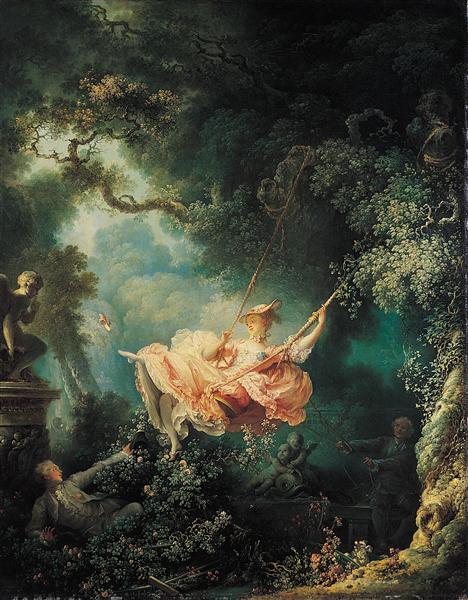
Rococo infused the world of art and interior design with an aristocratic idealism that passionately embraced ornate ornamentation and intricate detailing. The paintings that emerged during this era were a celebration of Rococo’s grandiose ideals and its insatiable appetite for the opulent lifestyle of the aristocracy. Originating in France in the early 1700s, Rococo evolved into a lavish fusion of decorative and fine arts, permeating the visual landscape of 18th century continental Europe.
In the realm of painting, Rococo drew significant inspiration from the Venetian School’s vibrant use of color and exploration of erotic subjects. Influential artists such as Giorgione and Titian played a pivotal role in shaping Rococo’s emphasis on swirling colors. One notable work, “Pastoral Concert” (c. 1509), initially attributed to Giorgione but now credited to Titian, exemplified the emergence of the Rococo style with its depiction of two nude women and aristocratic men playing music in an idyllic pastoral landscape. This painting heavily influenced the development of Rococo’s “Fête galante” genre, which portrayed courtship and aristocratic pastimes. The term “Fête galante” gained popularity through the works of Jean-Antoine Watteau, whose masterpiece “Embarkation for Cythera” (1717) effectively launched the Rococo movement. The French Academy used this term to describe the painting, thus establishing it as a dominant category within Rococo art. Depictions of elegantly dressed aristocrats engaging in leisurely activities, such as wining, dining, and pursuing amorous encounters in Arcadian gardens and parks, became immensely popular. This subject matter not only appealed to private patrons but also met the standards of the Academy, which held historical and mythological subjects in high regard.
At the start of his artistic career, Watteau trained in the studio of Claude Audran, a renowned decorator, where he encountered Claude Gillot, known for his decoration of commedia dell’arte, or comic theater productions. Consequently, Watteau’s works often embraced a theatrical approach, featuring figures dressed in elaborate costumes against backdrop scenery, enhanced by artificial lighting. While working with Audran, Watteau also copied Peter Paul Rubens’ series of paintings depicting the Life of Marie de’ Medici, displayed at the Luxembourg Palace. Rubens’ series, which combined allegorical figures and mythological subjects with portrayals of the Queen and the aristocratic court, continued to influence Watteau’s art. Watteau became so adept at the technique of “trois crayons,” employing red, black, and white chalk to create a coloristic effect, that his name became associated with it. This technique was widely adopted by later Rococo artists, including François Boucher.
Inspired by Rubens and Watteau, Boucher emerged as the most renowned artist of the mature Rococo period, spanning from the 1730s to the 1760s. His paintings captured a harmonious blend of aristocratic elegance and sensual representations of the nude form, exemplified in works like “The Toilet of Venus” (1751). Boucher’s influence extended beyond painting and embraced decorative arts, theatrical settings, and tapestry design. In 1765, he was appointed as the First Painter to the King. However, Boucher is most celebrated for his longstanding association with Madame de Pompadour, the official mistress of King Louis XV and a prominent arts patron.
Madame de Pompadour, born Jeanne-Antoinette Poisson, earned the title “godmother of the Rococo” for her pivotal role in promoting the style and establishing Paris as the artistic capital of Europe. She exerted her influence through her patronage of artists such as Jean-Marc Nattier, sculptor Jean Baptiste Pigalle, wallpaper designer Jean-Baptiste Réveillon, and gemstone engraver Jacques Guay. Madame de Pompadour remained a trusted advisor and confidant of the King until her untimely death at the age of 42. Her position and patronage served as the de facto definition of royal support for the arts. Other notable artists of the French Rococo period included Jean-Baptiste van Loo and François Lemoyne, the latter renowned for his historic and allegorical paintings, such as “Apotheosis of Hercules” (1733-1736), which adorned the ceiling of the Salon of Hercules at Versailles. Notably, French Rococo painting often displayed a consistent style and subject matter within influential artist families, such as the van Loos.
In Italian Rococo, painting took center stage, exemplified by the works of Venetian artist Giambattista Tiepolo. Tiepolo combined the Venetian School’s emphasis on color with quadratura, creating expansive ceiling paintings and large altarpieces. His masterpieces, admired throughout Europe, earned him numerous royal commissions, including his acclaimed “Apotheosis of the Spanish Monarchy” (1762-1766) in the Royal Palace of Madrid.
Italian Rococo was also distinguished by its landscape artists known as “view-painters,” with Giovanni Antonio Canal, popularly known as Canaletto, being a highlight. Canaletto pioneered the use of a two-point linear perspective in his depictions of the canals and festive atmosphere of Venice. His works, such as “Venice: Santa Maria della Salute” (c. 1740), were highly sought after by English aristocrats. In the 1700s, it became customary for young English nobles to embark on a “Grand Tour,” visiting renowned sites across Europe to deepen their understanding of classical Western culture. Venice, with its hedonistic carnival ambiance and picturesque vistas, was a popular stop on these tours. Furthermore, these young aristocrats often indulged in art collecting and patronage, making Canaletto’s paintings coveted among the English audience. In 1746, Canaletto relocated to England to be closer to his art market, residing there for almost a decade.
Rosalba Carriera, renowned for her pastel portraits, both miniature and full-size, as well as her allegorical works, enjoyed immense popularity throughout Europe. She received invitations to the royal courts of France, Austria, and Poland. Carriera revolutionized the use of pastels, previously employed mostly for preparatory drawings, by binding the chalk into sticks and developing a wider range of strokes and prepared colors. Her “Portrait of Louis XV as Dauphin” (1720-1721) established a new style of Rococo portraiture, emphasizing visual allure and decorative impact.
English Rococo, often referred to as the “French style,” displayed a more restrained approach due to the influence of somber Protestantism, which reacted against the excesses associated with the Rococo style. Prominent British artists such as William Hogarth, Thomas Gainsborough, and the Swiss-born Angelica Kauffman embodied the English Rococo aesthetic. In his book “The Analysis of Beauty” (1753), Hogarth advocated for the use of a serpentine line, considering it both organic and aesthetically ideal. Gainsborough, initially a student of Gravelot, who had been a pupil of Boucher, incorporated feathery brushwork and a vibrant color palette into his portraits, imparting a sense of fluidity and luminosity. Angelica Kauffman, though Swiss-born, spent the majority of her life in Rome and London. Between 1766 and 1781, she resided in London, where prominent artist Sir Joshua Reynolds greatly admired her portraiture. Kauffman, one of only two women elected to the Royal Academy of Arts in London, played a significant role in advancing both the Rococo style and subsequently the Neoclassical style.
In 1750, Madame de Pompadour sent her nephew Abel-François Poisson de Vandières to study developments in Italian art and archaeology. His experiences ignited a passion for classical art, leading him to advocate for a Neoclassical approach upon his appointment as director of the King’s Buildings. Vandières also became a respected art critic and openly criticized Boucher’s “petit style,” tarnishing the reputation of one of Rococo’s leading artists and its most influential patron. Influential thinkers of the time, including philosopher Voltaire and art critic Diderot, echoed this sentiment, denouncing Rococo as superficial and decadent. Combined with a rising revolutionary fervor in France, these criticisms resulted in Rococo gradually falling out of favor by 1780.
The emergence of Neoclassicism, led by artist Jacques-Louis David, marked a significant transition from Rococo. Neoclassicism celebrated heroism and moral virtue in its art. David’s art students even chanted a derisive rhyme, “Vanloo, Pompadour, Rococo,” explicitly targeting Rococo’s leading artist and its prominent patron. Consequently, by 1836, the term “rococo” began to denote something “old-fashioned,” and by 1841, it took on a negative connotation, representing works deemed “tastelessly florid or ornate.” These negative perceptions persisted into the 20th century, reflected in the 1902 Century Dictionary definition, which associated Rococo with anything “feebly pretentious and tasteless” in art or literature.
While painting gradually receded from the Rococo spotlight, Rococo design continued to enjoy popularity, particularly in the French provinces. During the reign of King Louis Philippe in the 1820s, a revival called the “Second Rococo” or Victorian Rococo style gained traction and spread to Britain and Bavaria. In Britain, the revival came to be known as the Victorian Rococo and remained influential until around 1870. It also influenced the American Rococo Revival in the United States, spearheaded by John Henry Belter. The style, often employed in upscale hotels, continued to be celebrated well into the 20th century and even became associated with the renowned “Le gout Ritz.” However, in the realm of painting, Rococo gradually faded, with the exception of the genre paintings of Chardin, highly acclaimed by Diderot, which continued to exert influence and later left a profound impact on artists such as Paul Cézanne, Édouard Manet, and Vincent van Gogh.
It was Edmund and Jules de Goncourt who rediscovered the major Rococo painter Jean-Honoré Fragonard in their publication “L’Art du XVIIIe siècle” (Eighteenth-Century Art) in 1865. Fragonard, in turn, influenced the Impressionists, particularly Pierre-Auguste Renoir and Berthe Morisot. Fragonard’s influence also extended to contemporary artists such as Yinka Shonibare, Kent Monkman, and Lisa Yuskavage. Similarly, Watteau’s commedia dell’arte subjects, rediscovered by the de Goncourt brothers, left an imprint on Pablo Picasso, Cézanne, and Henri Matisse, as well as numerous poets like Paul Verlaine and Guillaume Apollinaire, composer Arnold Schoenberg, and choreographer George Balanchine.
The term “Rococo” and its associated artists have undergone critical re-evaluation only in the late 20th century, as movements like Pop Art emerged, and artists such as Damien Hirst, Kehinde Wiley, and Jeff Koons provided a fresh context for ornate, stylistic, and whimsical expressions in art. Rococo’s influence can also be observed in Ai Weiwei’s “Logos” (2017), where seemingly intricate rococo wallpaper designs in black, white, and gold conceal motifs of handcuffs, chains, surveillance cameras, Twitter birds, and stylized alpacas – a clever artistic commentary on censorship. Moreover, the movement continues to resonate in popular culture, as evidenced by Arcade Fire’s hit song “Rococo” (2010).
 Emad Taha