Art movement
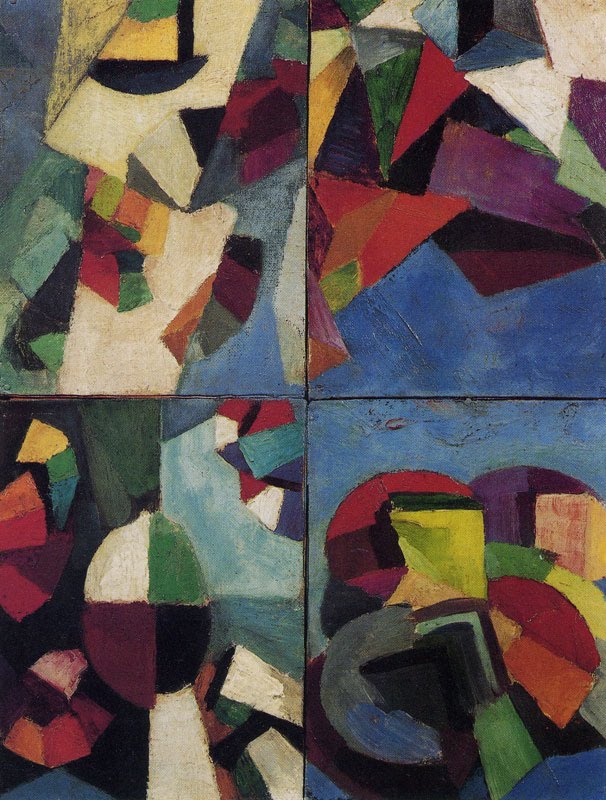
Synchromism, founded in 1912 by American artists Stanton MacDonald-Wright and Morgan Russell, emerged as a groundbreaking art movement in the United States. Their abstract “synchromies,” which drew parallels between color and music, marked some of the earliest abstract paintings in American art history. Despite its relatively short existence and limited following, Synchromism gained international recognition as the first avant-garde art movement in America. Describing Synchromism as a coherent style poses challenges due to the presence of both purely abstract and representational works within the movement.
At the core of Synchromism lies the belief that color and sound share similarities, enabling the orchestration of colors in a painting to evoke the same complex sensations as music. MacDonald-Wright and Russell aimed to create visual works that mirrored the harmony found in symphonies by painting in color scales. As MacDonald-Wright eloquently stated, “Synchromism simply means ‘with color,’ as symphony means ‘with sound.'” This exploration of synesthetic experiences, where the senses intertwine, was also central to the work of Wassily Kandinsky, who was concurrently developing his own synesthetic compositions in Europe.
The abstract “synchromies” were constructed using rhythmic color forms with progressing and receding hues. These paintings typically featured a central vortex that exploded into elaborate color harmonies. Synchromists consciously avoided traditional techniques such as atmospheric perspective or line, relying solely on color and shape to convey form. MacDonald-Wright and Russell, along with other avant-garde artists of that era, believed that realism in visual arts had reached its limits and that painting needed to break free from traditional notions of perspective and literary narratives to remain relevant in the modern world.
Early Synchromist works bore similarities to the vibrant expressions of Fauvism, while the multi-colored shapes also loosely resembled those seen in the Orphism movement pioneered by Robert and Sonia Delaunay. However, MacDonald-Wright adamantly asserted that Synchromism was a distinct art form, stating, “It has nothing to do with Orphism, and anybody who has read the first catalogue of Synchromism… would realize that we poked fun at Orphism.” While debates among art historians persist regarding the influence of Orphism on Synchromism, it is evident that the Synchromists drew inspiration from Cubism. They incorporated the fragmented planes characteristic of Cubist works, yet their use of lavishly saturated colors created a unique visual effect, akin to “eddies of mist, the droplets of which collect to form parts of a straining torso,” as described by art historian Abraham Davidson. Comparable examples of such vivid expression in American painting would only emerge in the color-field canvases of Jules Olitski during the 1960s.
The development of Synchromism took place in Paris, where Stanton MacDonald-Wright and Morgan Russell studied during the early 1910s. MacDonald-Wright, in particular, deepened his understanding of color theory by studying under optical scientists such as Michel-Eugene Chevreul, Hermann von Helmholtz, and Ogdon Rood. From 1911 to 1913, both artists received instruction from Canadian painter Percyval Tudor-Hart, whose color theory linked color qualities to musical qualities, such as hue to tone and saturation to intensity. The Impressionists, including Cézanne and Matisse, with their emphasis on color over drawing, provided further inspiration, as did the Cubists. Emile Bernard’s Cloisonnist style and Paul Gauguin’s exploration of color properties and effects also influenced MacDonald-Wright and Russell. In 1912, Russell coined the term “Synchromism” to explicitly convey the intertwined relationship between painting and music.
 Emad Taha